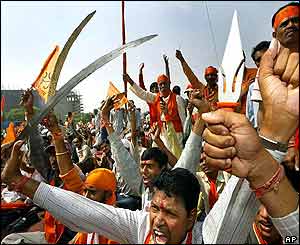
The region has seen a lot of strife and bloodshed
but there are numerous traditions of peace and cultural pluralism that are
thriving. Why not focus on these when we build memorials? We should be
conscious of our responsibility towards the future generations
Instead of creating memorials that remind us about violence, we should be
building memorials of peace and reconciliation like this memorial (R) of
writer Robert Burns (L) in Edinburgh
IN the past few years there has
been a splurge in the construction of several significant memorials and museums
on certain select facets of the history of Punjab. The most ambitious among
these are the Khalsa Heritage Memorial, Wada Ghalughara at Kup Rahiran in
Sangrur district, Chhota Ghalughara in Chak Abdalwari in Gurdaspur district and
Chhaparchiri in S.A.S. Nagar (Mohali).
The most recent addition in this
list is the proposed memorial on Operation Bluestar within the Golden Temple
Complex (Amritsar), which I thus see in a sense of continuity. Significantly,
all these memorials have a peculiar character and tend to engage with
particular kinds of histories of martyrdom, wars, violence and genocide that
the region has suffered since the 16th century.
The framework of time and space
with which these memorial engage with relates to specific episodes within the
realm of political conflict of the Sikhs against the Mughal state and later the
Colonial government on the one hand, and contemporary post-Independence state
on the other.
A broad construction of region’s
history through these memorials bring to fore the idea that Punjab has always
been engaged in wars, conflicts, invasions and violence which is dominantly
religious in nature. These memorials are also premised on the creation of a
binary of Sikhs against the Muslims, the British and more recently the Hindus. In a limited perspective, these
museums and memorials intend to narrate and retell significant sacrifices made
by Sikhs fighting against injustices and oppression of various hegemonising
tendencies.
However, as a historian one seeks
to contest the limited frames of these narratives since they leave out more
significant histories of peace, which has inspired centuries of co-existence
between various communities. In this context, I raise a fundamental question of
‘intent’ and seek to explore the choices which sectarian politics impinges upon
the public domain for narrow political gains? After all. what is it that we
want to leave for future generations to remember?
I am sure none of us would like
to promote re-emergence of bloodshed and violence for the youth of Punjab. How
should we then remember yet forgive and forget those facets of terrible
histories which left indelible scars on popular memory and reconcile them with
contemporary realities?
How would creating war and
violence memorial make better humans out of our generations? I propose, as many
others have, that if we keep larger objective of building the future Punjab in
mind, we should be building memorials of peace and reconciliation. This
objective cannot be achieved through selective tales of shared memories of violence.
In the context of the Partition,
documentary filmmaker Ajay Bharadwaj underlines that while narrating the tales
of violence, "We often prefer to shut out the whole episode with a wall of
silence," and instead target Muslim communalism, which is dominant in the
narratives of popular Partition histories and continue to be taught in the
schools and colleges of the region.
Similarly, the violence
experienced during the terrible days of terrorism in Punjab is vetted out
against each other by the Sikh and the Hindu communalists. Is there then any
‘final solution’ of these vexed issues? Can we ever emerge out these binaries?
Fortunately, there are numerous parallel narratives of peace, which continue to
inspire the lived lives of Punjabis in contemporary times and have been
nurtured threw centuries of shared coexistence. Why should these narratives be
missing from the historical discourse of the region? Let us briefly discuss
some of these narratives.
I begin with the second half of
the 16th century. The popular tale of Dulla Bhatti (a Rajput Muslim zamindar),
which is continually narrated during the Lohri festival of Punjab, retells the
story of how in a dominantly Muslim province of Punjab, a local zamindar saved
the ‘honour’ of two (Hindu) Brahmin girls, from the gaze of a Mughal officer,
who, on hearing about their beauty, wanted to acquire them, by secretly
arranging their marriage.
The tale continues to be popular
among the Sikh-dominated province of Punjab. I emphasise the religious (though
non-descriptive) identities here to highlight how kinship relations and local
ties in medieval Punjab where intertwined with caste and ethnic identities and
played a significant role on shared existence amid the centralising tendencies
of Mughal state.
Two narratives associated with
the tenth Sikh guru retell the stories of Bal (baby) Gobind and the sacrifice
of his two young sons. Pir Bhikam of Patiala had this ‘dream revelation’ that a
new sun had risen in the east at Patna. He and two of his murids embarked upon
a journey to the town to seek the blessings of the baby and dispel the doubts
of the latter. They also carried along two pots of sweets, one from the house
of a Hindu and another from the house of a Muslim. At Patna, the saint placed
two pots of sweets in front of the child, desiring to know what would be his
attitude to the two major religious traditions of India. As the child covered
both the pots simultaneously with his tiny hands, Bhikham Shah felt happy
concluding that the new seer would treat both Hindus and Muslims alike and show
equal respect to both.
In the second narrative, when two
young sons of Guru Gobind were captured by Wazir Khan, the Nawab of Malerkotla,
Sher Muhammad Khan wrote a letter to Aurangzed protesting against the Emperor’s
order to execute innocent boys. Guru Gobind apparently thanked the nawab and
proclaimed that the Sikhs of the region will henceforth offer their oblation to
the buried patron saint Haider Shaikh of Malerkotla. Guru Gobind’s sons could
not be saved, neither did Aurangzeb survive. But, until today the memory of
this episode continues to draw both Sikhs and Hindus to the shrine of Haider
Shaikh and over the centuries this narrative has transformed into a cultural
idiom of shared sacred space. One is reminded of Gandhi’s famous critique of
dominance of violence in the narratives of history where he says that "the
fact that there are so many men still alive in the world shows that it is based
not on the force of arms but on the force of truth or love" which has guided
the course of history.
I thus again seek to raise this
fundamental question about envisioning the kind of society we want for our
future generations. Amid the spirals of violence which continue to determine
region’s history, it is the hope of peace and reconciliation which should
determine the imagination for the future. Can’t we have a memorial where we
collectively mourn the killings of innocent people during the last century; a
memorial which condemns violence meted out against Hindus, innocent Sikh youth,
human rights activists and also millions of those who were killed in violence
of Partition? We need to ponder over these questions rather than glorify one
form of violence over the other. Resistance to an oppressive order is justified
only when it is itself committed to peace. At least, this is what centuries of
historical encounters tell us with the hope that ‘lest we forget’. We also need
to recover the narrative of shared existence from a generation which will soon
be lost unrecorded in the annals of written histories.
In the midst of recent Supreme Court verdict on 07 June 2010 in the Union Carbide gas leak case, Bhopal has once again drawn attention of national and international debates. We were a team of eight members comprising of a professor each from Canada, Delhi and Amritsar, two students from Canada and a reporter from BBC London along with two locals, who visited the premises of the Union Carbide factory at Bhopal on 12 July 2010. Our team was denied entry beyond the second gate and asked to seek permission from the Collector’s office.
Bhopal is a pertinent example of criminal impunity of the perpetrators of a heinous crime by the state against its own citizens. It is a gory example of a development model where lives of common folk are discounted to create hazardous mega-structures in the name of economic growth. Significantly the site where Union Carbide was setup was then the periphery of the city where the people on the margins lived in a slum (basti) right opposite to its premises and whose lives did not carry much significance to those in power.
A cancer patient who does not have enough funds to buy medicines (Photo by Simon Chilvers)
Among the victims of the tragedy we met Hamida Bi who looked visibly old and spoke vividly of the time she has seen, right from the fateful night of the gas leak to systematic loss of lives of her family members including her husband and children. Hamida has also been central to the mobilization of women in the entire movement against the state machinery which has continuously expressed lack of seriousness for the victims of tragedy. She narrated how in the event of mishap and at the behest of the authorities, the area was cleared of people and dead bodies of Muslims where buried enmasse and Hindus were burned without religious rites.
Subsequently Bhopal victims have been fighting a joint battle in the court and public domain demanding compensation and quality access to the treatment of victims who continue to be affected by the after affects of exposure to the poisonous gas. We heard of cases of still-born infants, multiple disabilities of those otherwise born, prolonged tuberculosis, etc. Sadly the fake medicines provided by the hospital established by the state government, exemplifying utter contempt of Court injunctions, shattered the lives of the ailing victims instead of curing them. The vicious cycle of rising expenses on the treatment from private hospitals and clinics worsens the condition of those who are unemployed or have meager income to sustain their medical expenses, leading to continuous loss of precious lives.
The only available compensation that government has been forced to pay has been from the verdicts of the court. Rukhsana Begum, another victim of the tragedy, narrated the incidents when during the exercise to ascertain the quantum of compensation the government officials would ask if their children were fake and illegitimate. The state reflects a cruel paradox when fully aware of its own ‘criminal neglect’ of its people, it instead tries to criminalize the latter. When the organs of the state cannot protect innocent lives, its very existence comes to question. This scenario is amply reflected in the entire tribal belt of central India where continuous neglect and exploitation of indigenous people has eventually led to an appropriation of the entire debate by Maoist violence.
This entire experience resonated with the lives of these two women who have lost almost everything in their lives. They are continually fighting battles in personal and public lives, trying to secure every bit of hope which attaches significance to their existence. From litigations, dharnas and advocacy to ensuring lives of continually ill members of family, their education and employment, these women are fighting crucial battle against the state authorities. It could not have been possible without the steadfast support of Jabbar Bhai who has stood by the cause of victims. Union Carbide tragedy has devastated the lives of thousands of people which are estimated to be 30,000 of those killed until now and more than a lakh who are suffering from multiple ailments.
The Centre has recently moved a curative petition to the Supreme Court seeking 11 fold hike in relief to the gas victims. The Tribune (December 4, 2010) quotes the figures of people dead as 5,295 (as compared to SC count of 3,000) and the number of cases with minor injuries as 5,27,894 (as against 50,000 estimated by the apex court earlier)
Rukhsana pointing towards the Union Carbide Factory (Photo by Simon Chilvers)
For the past sixteen years Swabhiman Trust took up the cause of providing training in multiple skills to Hindu and Muslim girls to give them a sense of dignity and help them support their families. It has rekindled hope for many and the centre has since then also become pivot of various activities for the victims of an unprecedented tragedy in human history. Swabhiman not only redefined the inter-communal relations of victims but also transformed the likes of Hamida Bi and Rukhsana Begum. Hamida proudly narrated how in the wake of tragedy she abandoned burqa. She has until now lost 35 members of her family in the tragedy. Rukhsana accompanied us to the families of Muslim and Hindu victims and would occasionally ask for photograph with the victims reflecting a sense of solidarity, a collective sense of hope.
Why aren't we discussing Ayodhya verdict? Are we comfortable with the idea that court has been fair enough for all the parties involved? The precedence set by the verdict has in a way de-legitimized the secular fabric of our country. Faith and that too majoritarian cannot be a justification for such a ruling. I am hearing Mr. Advani saying that the verdict has justified his rath yatras!!! What next??
Sad part is that earlier we used to think that higher Judiciary was perhaps the only organ of our constitution which was dispensing fair justice and was custodian of Law. The judgement ha shown least consideration for law. Faith and majoritarianism seems to have been major drivers of the judgement!
The fact if that the matter was primarily of ownership of property and while deciding this we have to somewhere decide the timeline from where we have to begin. Even if we presume that there was a temple below the mosque, how far can we stretch the debate of ownership; certainly not before British came to India when records of rights began to be maintained. And how can we justify the present demolition in a secular democratic INDIA on the pretext of an incident which is perhaps a reflection of a feudal arrangement.
Managing Conflict and understanding social behaviour form an integral aspect of any college/university administration. Conflict can literally be defined as disagreement or incompatibility at the level of thought. It can also represent a state of non-violent and even violent tussle, unrest and struggle. Thus when one tries to grasp the ways to ‘manage conflict in colleges’, the nature and conceptual framework of the conflict should be kept in mind. Further, the term ‘managing’ itself is problematic. It is significant to understand and devise ways to ‘resolve conflict’ than to ‘manage’ it. The latter implies a piecemeal arrangement, a proposition which is dangerous for Indian democracy as pertinent issues continue to remain unresolved. I intend to understand conflict through various perspectives, vis-à-vis personal and social.
Conflict generally begins at the emotional level. The ‘matters of home’ and the attitudes of parents are crucial to the genesis or resolution of conflicts within self and with others. Matters as trivial as parental dealing of a child’s emotional and material needs or behaviour and resolving conflict between siblings will be crucial to understand the origins of conflict. Dealing with opposite sex, with teachers, friends and colleagues and college authorities is something which an individual learns in the family. Thus family plays a significant role and every emerging issue in a college needs to be dealt through an active involvement and counselling of parents along with students. Student counselling should become an integral part of college administration.
Colleges and Universities constitute a crucial stage in the psychological growth of the youth in India. In a country where some colleges and universities lay emphasis on segregation of boys and girls within the classroom and outside, psycho-sexual conflict begins at this level. Further, the state also lays emphasis on establishing separate colleges for boys and girls, which further accentuates the conflict. Human desire to know the ‘other’ which involves multiple layers of sexual, emotional and social curiosities is the second step in understanding conflict. Colleges should focus on encouraging interaction between the ‘genders’. Inter-dining, inter-gender sports and dialogue should be encouraged to break the social barriers of caste, class and gender. It helps in breaking gender-related myths, reduces sexual tensions and is a first step in harmonising conflict in colleges.
Social behaviour also helps us in understanding day-to-day conflict in colleges. Notion of caste and class play a vital role in formulating these conflicts. Indian society has varied layers of caste and class hierarchies. Such notions inevitably foster ‘group-formation’ among students. Group-formation is essential to solidarity between members of various castes and classes, at times to resist oppression and hegemony. But in areas where social behaviour is marked often by feudal tensions of caste or/and class conflicts, such attitudes will be reflected in college politics too. Besides inter-state/ regional groupings also play a significant role in fostering solidarity on the one hand but also conflict on the other. Very often minor personal tussle transforms into inter-caste, inter-class or inter-regional conflicts.
Dealing with such conflicts requires rigorous encouragement of intra-caste, class and regional interaction which would help in breaking the narrow parochial barriers of social behaviour. The engagement of teachers and academia is extremely essential in this exercise. Academics have to find answers to issues related to the society and channelizing the energies of students towards constructive activities relating to their day-to-day problems. In addition to it, in a multi-ethnic/religious society like India, conflicts can also turn into inter-ethnic/religious violence. It is essential to engage students in critically debating on these issues, discussing and eliminating biases and fostering peace and cooperation.
Ideology has played a significant role in the emergence of student politics. In the 1960s-70s, student unrest in colleges was significantly determined by various ideological positioning. Elections to student council/bodies continue to be fought on the lines of state or national political parties. In a majority of cases party conflicts lead to apparently unavoidable conflict in colleges. Violent forms of such conflicts are condemnable but politics should be placed in a proper perspective. Rather the effort should be on shaping leadership and extending debates by organising discussions on political issues. De-politicisation is a serious character of students’ politics in colleges; the focus should be on guiding their energies on socially productive behaviour, critical thinking and nation building.
Efforts should be laid on building leadership but at the same time delinking students’ politics from narrow and divisionary party feuds. It is further essential to differentiate between physical violence and unrest. While violence is condemnable and unacceptable in any democratic society, unrest is crucial to the evolution of social thought. It strengthens criticality and dynamism in social behaviour. It is also essential to understand that equal participation of both boys and girls can inculcate cohesiveness and conjure social responsibility. It is also essential to engage students in academic debates which strengthens intellect and fosters democratic solidarity.
Conflict also manifests in the form of rampant gender-based eve-teasing and occasional cases of molestation in the colleges. Many colleges have enacted strict laws against such cases. These measures should be strengthened in colleges throughout India. Eve-teasing and molestation degrades human and individual dignity and ruptures emotional integrity. Though laws can act as effective deterrent, it is essential to engage and sensitise the perpetuators of such violence. There are other forms of violence, for instance in the colleges and university hostels of Panjab University, where students are often known to hurling both physical and verbal abuses on mess/canteen workers who live in pitiable conditions. Authorities should be intolerant to such incidents. These migrant workers suffer from multiple forms of alienation. Their living conditions are a grim reminder of our social reality. Students should rather engage with such core issues of progressive politics.
Violence is an articulation of emotional, sexual and psychological anxieties on the one hand and social, economic and political underpinnings on the other. Productive channelization of students and academic churning on these issues can be crucial to resolving and managing conflict in colleges. In cases of violent conflicts colleges resort to protective policing, but in the long run these measures should be corroborated with a more sustainable mechanism of conflict resolution. Yet there are other forms of conflicts between teachers, with management, which should be equally addressed in the interest of students.
Acknowledgements:This presentation benefits from a panel discussion 'Culture of Violence and Academic Atmosphere in PanjabUniversity’ organised by Critique on 26 August 2003. I am also thankful to Deepa Sharma for her useful comments. It was presented at the 80th General Orientation Course at Academic Staff College, Panjab Unversity, Chandigarh on 16 December 2008.
Bhagat Singh and his tirade against British imperialism has largely been studied and analysed either through nationalist, Marxist and revolutionary perspectives, or through terrorist and communitarian perspectives. These perspectives have until recently been dominantly elitist and give little space to popular representation of history. The book under review is an attempt to construct the image of Bhagat Singh from the perspective of the people. The study attempts to ‘explain him and his revolutionary career from the viewpoint of popular literary and cultural traditions of Punjab; how the Punjabi people, the carriers of these traditions, look upon him’ as a bridegroom (p.xiv). It is also an attempt to enlarge the debate on ‘representations’ in Indian historiography.
Gaur has divided the book into six chapters. He tends to theorise the various trends in historiography and literary traditions of India and emphasises that while political and state boundaries are different from the boundaries of cultural heritage, legacies both sectarian and nationalist are also too narrow to accommodate folk heroes of Indian subcontinent. He situates his argument in the context of historically evolved Punjabi ethos of non-conformism, non-sectarianism and counter-hegemony, which have been crucial to an understanding of the history of Punjab. These folk representations testify that during the struggle against British imperialism, the general people of India were not passive and dormant participants. ‘They were an active social force who responded enthusiastically and culturally to their martyrs, their struggles and their martyrdoms.’ (p.9)
The author tries to locate the trajectory of ‘a Punjabi martyr’ and their martyrdom in tradition and history through various narratives of ‘Sikh’ martyr Guru Arjan Dev, ‘outlaw’ martyr Dulla Bhatti, ‘lover’ martyr- Hir-Ranjha, Sassi-Punnun and Sohni-Mahiwal, ‘patriot’ martyrs like Bhagat Singh and others. Bhagat Singh is understood as a human being imbued with emotions and sentiments, a social liberal crusader against caste through a network of alliances’, a prolific writer and an organic intellectual who through his art of rhetoric and metaphor uses various simile, metaphor and legends from Indian history, an actor who unfolds various hues of his personality and as a prisoner committed to intellectual growth and political rights of prisoners in colonial India. Thus Bhagat Singh emerged a hero even before his death and descended deep into the minds and hearts of the people of Punjab.
The most significant treatment of Bhagat Singh is the popular depiction of his martyrdom. These folk representations provide an alternative discourse for understanding the literary and cultural context of the ‘month of martyrdom’ when Bhagat Singh was executed. Gaur probes the writings of Kalidasa, Guru Nanak, Bulleh Shah and others, and locates the advent of spring season with social change, playing of Holi with self-sacrifice and eagerness to meet his fiancée, death. Folk songs, especially the genres of ghori, marhi and qissa, and their themes of love and eroticism, of heroic and chivalric activities and of sacrifice and martyrdom are instrumental in the evolution of death-bridegroom or marriage-martyrdom motifs in the historical trajectory of Punjab. The image of virgin-martyr Bhagat Singh, narrated in the folk genre of qissa, is more revealing and multifaceted than the nationalist and Marxist narrations. Folk culture reinvents the virgin-martyr and weds him to death.
Dialogical narration is a peculiar characteristic of Qissa Bhagat Singh. The range emotions, sentiments and the inanimate objects which are used as metaphors in qissa are essential to situate the history of emotions. Bhagat Singh di Marhi is an elegy written on the aspirations for freedom by Bhagat Singh who for their realisation wedded death and devalued the significance of the death penalty. Thus, Bhagat Singh belongs to the Punjabi space which resonates with the legends of the virgin-martyrs or martyr-bridegrooms like Salar Masud Ghazi, Haqiqat Rai, Ajit Singh, Jhujhar Singh, Zorawar Singh and Fateh Singh. His ancestors are ‘virgin’ martyrs and therefore he is well grounded in the history and culture of Punjab and is assigned vernacular sensitivity and specificity through cultural idioms, customs and traditions. This work is of immense significance for general reader and those interested in alternative discourse in Indian history.
The city of Amritsar is unique in a number of ways. On the first day of navratras (nine days of fasting and festivity before the day of Dusshera), hundreds of children and adults (unmarried sons) dressed as langurs can be seen on the streets of the walled city flocking to Bara Hanuman Temple at the Dugiana Temple complex to celebrate the langur-mela. Not only Hindus but Sikhs and Muslims also dress their children in colourful princely-attire like monkeys after fulfilment of their wish of a male child.
Langur-mela typifies the intensity of hyper-masculinity in Amritsar. According to Surinder Kumar Billa the president of All-India Hindu Shiv Sena more than 10,000 langurs throng the Temple during navratras (The Tribune, Amritsar Plus, 13 October 2007). Punjab has been historically been notorious for its low sex-ratios (with general sex-ratio at 849) and the practise of female infanticide and foeticide. With urban sex-ratio of 862 (per 1000 males), Amritsar may not fare as bad as its counterpart Ludhiana with urban sex-ratio at 783, but the former is an epitome of culture (Punjabi-sabhyachar) and has a bearing not only on Punjab but also bordering districts of Himachal Pradesh.
Conversions, Caste and Communalism: Globalisation, State and Challenges of Secular Politics in India
By Yogesh Snehi
In the past two years the debates on religious conversions, caste and communalism have gripped India in a serious imbroglio which is fallout of the present nature of state politics in the country. The years 2007-08 have been the most volatile ever since the anti-Godhra riots in the state of Gujarat in 2002, which exposed the role that the governments in India have played in arousing communal passions through state machinery. These are difficult times, and the time that would follow poses more complex challenges for state-politics in India.......
For reading the complete article click the link below;
The Tribal Situation in India edited by K. Suresh Singh (IIAS, Shimla, Pages: 610. Price: Rs. 600 )
SANJOY Hazarika has repeatedly reminded and cautioned successive Indian governments about the dangers of ignoring the predominantly tribal North-East. Indian tribals, as is well known, are the indigenous population of the land. Yet, they are the most neglected ones—economically, socially and politically. After Independence, with the emergence of different tribal states, significant changes have taken place.A large number of tribals are flocking to the cities for education and employment. But, the fact is that till today these communities have not been able to identify with the mainstream.
The book under review is a revised edition of the papers presented at a seminar on "The tribal situation in India," way back in 1969, at the Indian Institute of Advanced Study (IIAS), Shimla. The work deals with a wide range of tribal issues and has been divided into three parts.
The first part details the inauguration to the seminar. The second part focuses on the papers and has seven sub-parts titled as: Regional Tribal Situation: Perspective and Problems; Social and Cultural Communication; Policy, Politics and Administration; Agrarian Issue and Development; Movement and Leadership; Problems of Integration and Family; A summary of some of the remaining papers. Part III is dedicated to the discussions spead over 10 business sessions.
The significance of the work can be judged from the fact that 18 anthropologists 14 sociologists, four social workers, two journalists, six tribal leaders, four administrators and 17 representatives of tribal research institutes have participated in the work. The scope of participation makes the work inter-disciplinary. In all, there are 51 papers, out of which 10 have been summarised. These papers tend to highlight the problems that Indian tribes have been facing and suggest methods to tackle them. The work, in this sense, becomes important from both the academic and national point of view. It tends to evolve certain policy guidelines on general problems of national unity.
The inaugural address traces the history of the contemporary tribal scene. The diversity of tribal situations evokes a reader’s interest. While the North-East has seen a high rate of politicisation, Central India has set a good example of acculturation. The results are equally distinct. While the situation in the North-East has taken the shape of insurgency, the latter has witnessed tribal uprisings and increased confrontation between the tribals and non-tribals.
Successive governments have tried to devise ways in which this alienation and isolation of tribals can be put to an end. The book suggests opening up of borders along Bangladesh and ways in which trade ties can be established. Here, another problem of influx of refugees emerges. As in Assam, where the tribals have become a minority. Perhaps a rail-road link through Bangladesh will help. The book also draws attention to the role of Christian missionaries. Today, Mizoram boasts of high literacy and awareness levels. Changes are evident in Himachal Pradesh. Monetisation of the tribal economy has helped the tribals in improving their economic lot. Their peas and potatoes now find a market throughout India.
The tribal situation, as of today, has been the result of a series of developments since the advent of the British. Social movement among various tribes has its roots in the British period. The Chhota Nagpur revivalistic movement and the Jharkhand movement against land alienation and exploitation are of reader interest. Keeping in mind the antiquity of the situation, the problems of tribals will have to be traced to the developments during this period. These papers offer a great lot of details to study these emerging situations.
Issues like integration of tribals are indeed very complex. Recent extension of the ceasefire with the Nagas offers hope. But a lot has to be done to lessen the complexities that engulf tribal India.Rapid development will only widen the gap between tribals and non-tribals and industrialisation will restrict them to the fringe. The book makes certain suggestions: redefinition and rescheduling of tribes; easing tensions among tribals and with non-tribals; safeguards for tribals within an overall plan of speedy national reconstruction and development; integration into the mainstream without the loss of cultural identify. The Press, media, voluntary agencies and social scientists will have to play an important role in it.
The book contains rich statistical details. Discussions towards the end act as reviews of presentations and make the work critical. There are hardly any good books available to deal with the issue of tribals in detail. This revised edition will be of immense use for policy makers, researchers, general readers and even NGOs who are interested in working with tribals. But, this work lacks information about tribes in Uttar Pradesh, Gujarat and Rajasthan. The book also does not have an index, which is expected from any standard work. Despite this, the book offers hope for peace in turbulent tribal India.
Wage Rights, Social Security and Academic Institutions: Will the Bills for Unorganised Sector Workers help?[1]
-Yogesh Snehi
Abstract
India has significantly large presence of the unorganised labour that has been experiencing challenges of minimum wages and social security for a long time. The case study of the hostel mess/canteens in PanjabUniversity shows that the workers have been facing serious denials of their statutory wage rights. Besides this, the working conditions of workers are woefully inadequate and the University, as a Principal Employer has been unwilling to ensure the application of labour laws. This case study raises many questions about the notion of state, welfare and social security for the unorganised sector workers in India. In the absence of an assertion, can the Unorganised Sector Workers Social Security Bill 2005and the Unorganised Sector Workers (Conditions of Work and Livelihood Promotion) Bill, 2005 be of any help to these workers?
In 2004-2005, a concerted campaign was organized by Initiatives for Democratic Rights (IFDR)[2], Chandigarh, raising their voice against the violations of labour laws in the hostel mess/canteens of PanjabUniversity. More than 400 workers employed at the hostel mess/canteens of the University were being denied their basic wage rights. This campaign took different turns at various stages of its course; from raising the question of wage rights and mobilizing workers, to democratizing the issue among the students and demanding accountability through Right to Information Act, 2005. Until today the campaign hasn’t achieved much beyond the democratization of this subject, but it raises many questions pertaining to the struggle of the unorganized sector workers for wage rights in India. This paper takes up this campaign for minimum wages as a case study and tries to relate it with the notion of state and welfare in India. I will examine the relative silence of the authorities and the academia on this issue and its implications for the unorganised sector. I will also critically investigate Unorganised Sector Workers Social Security Bill, 2005 and Unorganised Sector Workers (Conditions of Work and Livelihood Promotion) Bill, 2005 and the relevance of these Bills for this sector.
Socio-economic Findings of the Survey
The idea behind conducting a survey on the mess/canteen workers of PanjabUniversity emerged out of a need to scale the widening gap between the issues raised by the mainstream academia and the empirical realities that we face in our contemporary society.[3] It seems quite a contrast that even while the academicians of Panjab University have been fighting for their pensions and allowances, these workers are trying to manage their lives with abysmally low wages. I do not intend to criticize the academicians here for pension benefits and allowances are their legitimate rights. But it remains an irony that within the same campus there are others who don’t have a voice and find it extremely difficult to raise demands for their statutory rights.
The survey primarily focussed on the socio-economic conditions of the mess/canteen workers employed in the hostels of PanjabUniversity. The members of IFDR interviewed the workers from the month of January to March 2004. In all thirty-six workers were interviewed using a questionnaire[4] to get specific information as well as additional discussion to get unstructured narratives from their lives. It was intended to be a representative cross section of the workers.[5]
The survey primarily highlighted the socio-economic conditions of the workers.[6] Virtually every hostel worker (in both boys’ and girls’ hostels) interviewed was a migrant labourer, all of them being males.Most of them had left their families as teenagers, coming alone or with their relatives to Chandigarh. The hostel workers left their homes in search of work due to the socio-economic deprivations they faced at their native places. A majority of them came from rural areas of Una and Kangra districts of Himachal Pradesh (HP) or from Uttaranchal. Some others came from Shimla and Chamba in HP, Madhubani in Bihar, Guwahati in Assam, Hoshiarpur in Punjab and Gonda in UP. Significantly, all these regions have relatively high rates of poverty and unemployment in India.
Land can ensure a minimum social security for the rural population. However, this depends on how much land is owned. The survey found that almost two-third of the workers were from families that were either landless or owned five or less kanals of land, which is barely sufficient even for subsistence farming. Most of the workers interviewed were between 19 to 25 years of age. Almost all of them joined the mess/canteen services between the age of 14 and 25. Two of them were below the age of 14 when they joined. While a majority of them had been working at this job for less than one year, a few had held the same job for as long as 42 years.
A worker’s age and the number of years of service should be an important factor in determining his wages and service entitlements. However, even those workers who had been working in the hostels for many years were not getting any better wages or entitlements than young boys who have been working for less than one year. To add to it lack of education was another source of deprivation. Although education itself does not necessarily guarantee job security but as Amartya Sen argues, it does enhance the capabilities to choose. However, we found that six workers among thirty-six were illiterate. While most of the mess/canteen workers had studied at least up to eighth standard, one had completed 10+2.
Caste discrimination can be one of the reasons why even educated people are forced to work under bad conditions at low-paying jobs. According to the survey, as many as one third to one half of these mess/canteen workers belonged to the Scheduled Castes or Other Backward Castes. This higher than expected ratio (given the lower percentage of these castes in the total population), indicates the continuing prevalence of caste discrimination in which the dalit population does not have equal opportunities to higher paying jobs.
Wages and Working Conditions
The University does not consider either the contractors or the workers as its regular employees. Therefore, the latter are deprived of the benefits to which the regular employees are entitled.[7] Most of the mess and canteen workers work for more than 12 hours each day, and all of them work for 7 days per week. None of them gets overtime pay for the extra hours worked.
Only three of the thirty-six workers interviewed got more than Rs.1500 pm. One worker merely received Rs.600 pm, and another got only Rs.1100 pm even though he had been working at the hostel for the past 42 years. Thus, there is an inequity in the correlation between wages, hours of work and years of service. Three workers who were getting the maximum salary were basically cooks, who worked fewer hours each day than the others. With such low wages and busy schedules, most of the workers could visit their native place just twice or thrice in a year. In most cases, the workers paid for whatever medicines they needed from time to time. Out of thirty-six workers just ten of them said that they received some medical benefits.
The conditions in which the workers live make a mockery of the welfarism guaranteed by the socialist notions of our Constitution. While some workers were sharing tiny sleeping rooms with 2 or 3 fellow workers, most used small rooms shared by 4 to 11 workers, with space for not even one bed per worker. In one girl’s hostel most of the workers sleep in the dining hall and use the toilets in an adjoining hostel.Toilet and bathing facilities are woefully inadequate and unhygienic.
Most of the workers were not satisfied with their working conditions. They felt bound by necessity since there are fewer opportunities of alternate employment available to them outside the university premises. Besides this, they often face verbal abuses. Two of them narrated incidents of their physical abuse by the hostel students. Seventeen workers also reported incidence of stress due to overwork. These were mainly canteen workers who work for more than eleven hours in a day. Although there are some facilities to accommodate the families of contractors, nothing is available for the workers’ families.
Question of Rights
Labour laws came into existence after decades of struggles over working conditions, hours of work and wage entitlements, etc. These reforms came into being with the parallel transformation in the 19th century vis-à-vis the nature of the State from feudalism to welfarism. Indian Constitution spells out the welfare character of the state based on the principles of social justice. Labour laws also extend the provisions for service and legal entitlements of labourers.
Any labourer/worker, whether on contract or regular basis, is entitled for certain basic rights. Firstly, the Minimum Wages Act of 1948 specifies the statutory minimum wages payable to a worker. The appropriate governments from time to time revise the rates under this act, keeping in mind the growing cost of living. The Labour Department of Chandigarh has fixed minimum wages as follows;
Category
1 April- 30 September 2004
1 April- 30 September 2006
pm (Rs.)
per-day (Rs.)
pm (Rs.)
per-day (Rs.)
Unskilled
2741.50
105.35
3211.50
123.20
Semiskilled (2)
2891.50
111.15
3361.50
129.00
Semiskilled (1)
2991.50
114.95
3461.50
132.80
Skilled (2)
3191.50
122.65
3661.50
140.50
Skilled (1)
3416.50
131.35
3886.50
149.20
Source: Labour Bureau, Chandigarh
Besides this, if a worker covered under these provisions and working in canteens, etc. is not provided any provision for food and accommodation, an extra payment of Rs.333.31 pm, increased to Rs.392.00 pm in April 2006, should be provided.
Secondly, the Factories Act of 1948 says that every worker shall be entitled to all the privileges and benefits applicable to the workers in a factory. These provisions relate to the hours of work; which includes (i) weekly holiday on the first day of the week (ii) work for not more than 48 hrs a week and not more than 9 hrs a day (iii) overtime for work more than 9 hrs on any day or more than 48 hrs in a week at the rate twice the ordinary rate of wages (iv) maintenance of a register of workers; health and safety of workers, food and accommodation, annual leave with wages in the subsequent Calendar year, if he has worked for 240 days or more in a Calendar year i.e. one leave for 20 days of actual working, in the case of an adult and one leave for 15 days actual working, in the case of a child.
Thirdly, the Employees Provident Fund and Misc. Provisions Act, 1952 says that a prescribed contribution has to be made by the principal employer in respect of contractor's employees. Fourthly, the EmployeesState Insurance Act, 1948 states that a contract worker is entitled to the benefits under this act. The principal employer is liable to pay both the employer's contribution and the employee's contribution in the first instance.
In addition to this, the Contract Labour (Regulation and Abolition) Act, 1970 has made it obligatory for the contractor employing contract labour to provide and maintain sufficient supply of wholesome drinking water and reasonable number of latrines, urinals, washing facilities, etc. Where the contractor does not provide such facilities and amenities, the responsibility shifts to the principal employer. Mess/canteens are provided under the statute i.e. The University Act. In the view of G B Pant University Vs the State of Uttar Pradesh, the University (in this case the Panjab University) is the principal employer of the workers employed in the hostels of the institution.
PanjabUniversity as a Principal Employer
The survey revealed serious violations of the rights of mess/canteen workers. Not even a single provision for workers pertaining to the maintenance of registers, minimum wages, hours of work, overtime, health and accommodation, leave entitlements, provident fund and employees' state insurance have been implemented in the Panjab University campus.
Workers receive wages far below the minimum wages. One of the worker interviewed received wages as low as Rs.600 pm. Most of the workers work for more than 9 hrs a day regularly. These working hours extend to 12 hrs for some canteen workers. They do not get any extra benefits for overtime. Besides this no worker gets a holiday in a week. Provision of health and accommodation is also inadequate. In some hostels they sleep on the dining tables. They are not provided annual leave with wages even though every worker works for more than 240 days in a year. When a worker goes on leave he is deprived of his wages even if he uses the leave to which he is entitled. The University (principal employer) does not maintain Provident Fund and Employees' State Insurance.
A Judgement of Supreme Court of India in the case of G.B.PantUniversity of Agriculture and Technology, Pantnagar, Nainital Vs The State of Uttar Pradesh and Others, directed the University authorities to regularise the services of the employees and entitle them to get monthly wages at par with the other employees of the University. This judgement has a bearing on the workers of mess/canteens in PanjabUniversity.
Admittedly, Cafeteria employees need succour – would they continue to remain half fed and half clad as long as they live– is this the society that we feel proud of? Is this the guarantee provided by the founding fathers of our Constitution or is this the concept of socialism which they conceived? None of the answers can possibly be in the affirmative. The situation is rather awesome and deplorable – the University by compulsion directs students to be residents of hostel with a definite ban on having food from outside agencies excepting under special circumstances and the provider of food, namely, the staff of the Cafeteria ought not to be treated as an employee of the University…[8]
The University, through the Dean Students’ Welfare (DSW) enters into a procedure of appointment of contractors for one year (renewed every year) on the basis of an ‘Agreement Bond’, which mentions the terms and conditions of the contract. Here the University acts in the capacity of a ‘principal employer’. The Agreement Bond regulates the functioning of mess/canteens. It not only specifies provisions of basic furniture, fuel, cylinders, cooking utensils, etc., which are provided by the University but also emphasizes the guidelines pertaining to the rights of workers. Also the ration to run these mess/canteens has to be essentially purchased from the University.[9]One the one hand it lays down the standard of food, appoints a dietician to check the quality of food and fixes the rates of diets, while on the other hand it instructs the contractors ‘to observe and follow general labour laws, employment acts and wage rules’ [Agreement Bond 2004: 2]. The University also undertakes the collection of mess/canteen dues from the students and pays it back to the contractor after deductions.
In a way the University acts as the ‘principal agency responsible for the employment and welfare of workers’, and should comply with the legal provisions. Its role becomes more interesting when it provides Rs.700 pm as a salary subsidy to the contractor as if he is an employee of the University.
The University regulates the employment of more than 400 workers working in various mess/canteen of twelve hostels. These workers start working with effect from 15th of July, when the session starts, till the month of May, for a span of around 10 months i.e. more than 300 days. Usually the worker continues with the work in the next session also as the contracts are ritually renewed every year. Also the contractor continues to work in the same hostel for years together until there is a serious breach of terms. The contractor of Mess-I of Hostel-6 had been working there for more than 20 yrs. Thus the contractors continue to work in the University system year after year and are sometimes mutually transferred but very rarely removed.
The University has also fixed rules and regulations for the students/residents regarding their association with mess/canteens.[10] It says that a ‘hostel has facilities for lunch and dinner as well as canteen services and a resident shall have meals in the hostel mess/canteen only (Rule 37-a); ordinarily residents will take food in the hostels and the residents are required to take at least 15 diets per month, failing which a minimum charge of 15 diets is to be paid by them (10 diets to be paid to the contractor and 5 diets to the Mess Development Fund) in the mess where they are residing (Rule 37-b); each resident will contribute charges of two ordinary diets per month (along with the mess bill) one towards food subsidy and one towards Mess Development Fund (Rule 37-f); for the meals missed by a resident, without the prior intimation, a charge of Rs.3 per meal will be imposed. It will be obligatory on the part of the residents to inform the Contractor/Cooperative Mess Secretary before hand if they want to miss a meal so as to avoid the wastage and loss. A register for this purpose will be available with the contractor wherein the residents should enter the information about missing the meals. A resident who is absent without leave from the Warden may miss meals for not more than seven days in a month (Rule 37-h).’ Further the fee structure of the hostel rulebook imposes (under item 46 B) contributions towards a Mess/Canteen Servants Welfare Fund @ Rs.10 pm and Medical Aid of Mess/Canteen servants @ Rs.40 pa on the students.
Thus mess/canteen services do not seem to be a mere welfare activity but is an essential requirement where sizeable number of employees work. These services are provided on a regular basis and the university cannot do away with them. Further, the University has total control in the matter of running and maintenance of the mess/canteens. The contractors have only been acting for and on the behalf of the University as its agents to provide the said services. The contractors engaged from time to time are in reality the agents of the University and are only ‘a veil’ between the University and the canteen workers. Hence the workers are in fact the employees of the University.
One of the most significant finding of the survey conducted by IFDR was either absence or low awareness of mess/canteen workers about the legal entitlements that are due to them. They are unaware that their working conditions are illegal. Some others do not have any faith in the law. This is despite the fact that many among them have completed their education up to at least eighth standard.
Campaign and Reaction of the Authorities
Low awareness amongst the workers gave an impetus to the efforts for development of a methodology to engage these unorganised workers with the issues of wage rights. A poster in Hindi which highlighted the basic wage entitlement of workers was prepared by the members of IFDR.[11] Meetings with workers were organised in the different hostels to make the workers aware of their wage rights. Efforts were also made to organise them so that they can meet regularly and discuss issues of minimum wages, living conditions, dealing with recurrent verbal and physical abuses from the students and evolving a possibility to create a pressure group which could evolve in the form of a registered body to press the authorities for their statutory rights. Significantly, when the president of fourth class union was contacted to take up the issue of mess/canteen workers, he expressed his inability to engage with them.
The result of this engagement was dramatic. The workers started turning up in significant numbers at the joint meetings which were preferably held in the evenings in the university campus. One such meeting was organised by the workers themselves at eleven in the night under the leadership of a canteen accountant of Hostel-2. More than three hundred workers from different hostels turned up at this meeting. It was disorganised and ill planned and the sheer number and the time sent the alarm bells ringing. The workers engaged in sloganeering and almost immediately the University security turned up and scattered them. Their leader was called up and given a warning. These developments lead to an almost immediate beginning of repression on the workers by the University authorities, especially hostel wardens.
In another development a worker of Hostel-4 was beaten up by some students on the charges of theft.[12] This agitated the workers and they decided to go on a strike. The workers of other hostels were gradually informed and a call for total strike was given. Though unorganised, these workers met at the law ground of the University.[13] The warden used this case as a justification to curb the activities of workers. Instead of trying the students who had beaten up the worker, the warden took to their sides. The leader of Haryana Students Association demanded that the workers be fined for striking. The warden criminalised the ‘community of workers’. All this happened in the common room of Hostel-4 in presence of another warden and a dietician. Since the charge of theft could not be proven the warden expelled the worker on the charges of selling cigarette and fined the contractor with Rs.5000.[14] The workers of other hostels were threatened with expulsion. Slowly the meetings came to a standstill.
In the meantime the authorities sent a circular that a three-day training workshop for the workers shall be organised in association with Ambedkar Institute of Hotel Management, Chandigarh. The programme was supposed to give lessons in cleanliness and cooking meat. It remains an irony that these workers who are unable to save sufficient money for their daily needs were given lessons in cleanliness, even while the authorities were themselves responsible for unhygienic living conditions of the workers. Besides this, lessons in cooking meat made a mockery of the workers as non-vegetarian food is not prepared in any hostel.
The reaction of the student community and the attitude of authorities raise many questions about the general insensitivity on the question of wage rights which prevails in our society. IFDR decided to work on this issue with a fresh perspective to bring the student community closer to the issues of the oppressed. Besides this, a parallel campaign to sensitize this issue in the University was launched.[15] The issue was also raised at the senate meeting held on 20 March 2005.[16] Subsequently, the Vice Chancellor assured the senate on constituting a Committee to look into the matter. But the findings of the committee were never made public and no steps were taken to follow up this issue. The Dean Students’ Welfare and the hostel wardens who had been acting notoriously at every stage have till today not given any statement on the violation of wage rights. Later in the second week of June 2005 fresh appointments of the contractors were made on the procedure followed in the previous years.
Meanwhile, IFDR undertook a poster campaign and brought forth issues like democratic/legal rights and welfare of workers, accountability, constitutional and statutory rights and respect for the labour laws.[17] These posters were put around the University campus and IFDR tried to sensitise the student community on the question of wage rights. But such issues are never taken up by student bodies engaged in election politics. An effort was made to make an enquiry into the utilisation of two funds (Mess/Canteen Servants Welfare Fund and Medical Aid of Mess/Canteen Servants) maintained for the welfare of workers through ‘Right to Information’. DSW office provided IFDR with a false statement on Income and Expenditure for these funds. IFDR questioned these details but repeated applications to the DSW and the appellate authority have fallen to deaf ears.
Indian Scenario
Indian scenario is not different from the case study of mess/canteen workers of PanjabUniversity. Unorganised workers are the most oppressed lots throughout India. While unionising gives a scope for effective bargaining to the workers in the organised sector, workers in the unorganised sector are doubly oppressed.[18] Labour Laws are not a guarantee for the unorganised sector since the temporary and insecure nature of employment makes it impossible for the workers to raise their voice on the issues of wage rights. The role of the State and Labour Bureaus as guardians remains ambiguous in the absence of an effective legal mechanism to monitor the implementation of wage rights in the unorganised sector.
There are numerous organisations in India demanding better wages and working conditions for workers in the unorganised sector.[19] But the presence of such organisations is diminutive keeping in mind the extraordinary large presence of unorganised workers. There is little room for overworked canteen and dhaba workers. Besides, there is an impending sense of realisation pertaining to the difficulties of the existing legal provisions.
Pointing towards the efficacy of the Minimum Wages Act, 1948, a ‘Report on the Working of Minimum Wages Act, 1948’ says that in a developing economy like India where about 90 percent of the workers work in the informal sector without having collective bargaining power, wages couldn’t be left to be determined entirely by the interplay of market forces and intervention on the part of the government becomes imminent. It says that it is with this objective of supposedly protecting the vulnerable and the less privileged strata of the society from exploitation by the capitalist class that government of India enacted the Minimum Wages Act, 1948. The Act provides for fixation and revision of minimum rates of wages in sweating employments by involving the authority of the state. It adds that the minimum rates of wages help in reducing the inequalities in the standards of living of different social groups of workers by statutorily prescribing minimum wage rates.[20] But, as far as unorganised sector is concerned, the above contention on the Minimum Wages Act may not be true.
Another ‘Report on Evaluation Studies on Implementation ofthe Minimum Wages Act, 1948’ says that the Minimum Wages Act, 1948 aims at preventing exploitation through the payment of un-duly low wages in such employments where‘sweated' conditions exist and the workers are vulnerable due to lack of organisation; illiteracy; ignorance and poverty etc. The Act, therefore, empowers the appropriate government for fixing the statutory rates of minimum wages and to revise the same at intervals not exceeding 5 years for the Scheduled employments.’ However, the report admits that the fixation of the statutory minimum wages in itself does not ensure that it is paid to the target workers. It requires effective enforcement on the part of appropriate authorities.[21]
In such a situation there is a need for an affective framework which can cater to the social security needs vis-à-vis minimum wages, education, health, insurance and housing needs of these people. The existence of present framework of laws like The Minimum Wages Act, The Factories Act, The Employees Provident Fund and Misc. Provisions Act, The Employees State Insurance Act and The Contract Labour (Regulation and Abolition) Act have hardly been helpful as Labour Bureaus and inspectors make a mockery of these provisions by being silent and passive. Our own experience has shown that repeated letters and appeals to the labour department fall to deaf ears.
The Unorganized Sector Workers Bill
Unlike the organized sector, there is no fixed employment relationship in the unorganized sector. The peculiar nature of the unorganized sector of around thirty-nine crore workers is the changing employer - employee relationships and the existence of a hierarchy of relationships.The employment is contractual, most often on a sub-contract basis and is unregulated and thus the workers are unprotected.Thus, to ensure security of employment and protection of workers, it becomes imperative to regulate employment in the unorganized sector.[22] Though social security laws such as the ESI Act, EPF Act, Payment of Gratuity Act etc., have been extended to the unorganized sector, constraints in their application have been experienced due to lack of continuity of employment, the changing employer - employee relationship and total lack of records pertaining to the details of employment.[23] Further, there was a felt need that minimum level of social security particularly in the areas of health, maternity benefits, disability & old age benefits must be provided, if necessary through public assistance also.[24]
There has been a significant headway on the issues of unorganised worker in the recent past. The National Campaign Committee for Unorganised Sector Workers has been working in many ways to moot provisions for social security of workers in the unorganised sector. It is an umbrella group of various organisations working in this sector. A major initiative on this issue came from the Ministry of Labour which brought out the third draft of Unorganised Sector Workers (Regulation of Employment, Conditions of Service, Social Security and Welfare) Bill in November 2004 and was put forth for discussion. Besides this, Sushma Swaraj also introduced the Unorganised Labour and Agricultural Workers (Welfare) Bill in July 2005. In August 2005, the National Commission for Enterprises in Unorganised Sector (NCEUS)[25] brought out two draft bills for workers in unorganized sector; Unorganised Sector Workers Social Security Bill, 2005 and Unorganised Sector Workers (Conditions of Work and Livelihood Promotion) Bill, 2005. On 16 May 2006, the Chairman of NCEUS, Arjun Sengupta presented a Report and a modified draft Bill on Social Security for Unorganised Workers to the K. Chandrasekhar Rao, Minister for Labour & Employment.
The Commission has proposed a ‘national minimum social security scheme’ for all unorganised workers, which shall include health benefits, insurance cover cum unemployment benefits for workers above poverty line (APL) and a pension of Rs.200 per month for aged workers living below poverty line (BPL). The scheme is proposed to be contributory in nature with workers employers and government contributing one rupee each per day towards the scheme. However workers living below poverty line will be exempted from their contribution which shall be paid by the central government on their behalf. The central and state governments in the ratio of 75:25 shall share the remaining government contribution.
Unorganised Sector Workers Social Security Bill 2005will cover all workers in the unorganised sector with a monthly income of Rs.5, 000 and below. This will include self-employed workers (including small and marginal farmers), wage workers and home based workers. In addition, informal workers in the organised sector without any social security cover (such as Badli workers and casual workers) will also be covered. The number of workers eligible for this cover is estimated to be around 30 crores. There will be a national minimum social security cover comprising (a) health insurance, (b) maternity benefits, (c) life insurance and (d) old-age pension for all eligible workers.[26]
Unorganised Sector Workers (Conditions of Work and Livelihood Promotion) Bill, 2005proposed by the Commission seeks to address the question of conditions of work for wage workers in the unorganised sector with a view to provide a basic minimum standard on hours of work, payment of minimum wages and adherence to Bonded Labour Abolition Act and Child Labour Prohibition & Regulation Act. It also recognises a set of minimum entitlement of the workers comprising (a) the right to organise (b) non discrimination in the payment of wages and conditions of work, (c) safety at the work place and (d) absence of sexual harassment.[27] In order to provide machinery for the resolution of disputes between wage workers and employers in the unorganised sector, the Draft Bill has proposed the creation of at least one Dispute Resolution Council in every district which would be constituted by the State Governments. Before adjudicating on a matter, the Dispute Resolution Council shall, in the first instance, try to arrive at a conciliated settlement of disputes. The Council will have the powers of a Civil Court under the Code of Civil Procedure.[28]
How far can the Proposed Bills go?
Unorganised Sector Workers Social Security Bill, 2005 and Unorganised Sector Workers (Conditions of Work and Livelihood Promotion) Bill, 2005 propose a framework for devising a social security mechanism and the furtherance of livelihood and work conditions of the unorganised workers. These Bills seek to propel and extend social security coverage to all the states and all the groups of workers in the unorganised sector. The experience of existing labour laws, however, demonstrates that the mere existence of legal frameworks may render the laws redundant in the absence of an efficient arrangement for their implementation, with effective checks and balances.[29] The case study of mess/canteen workers of PanjabUniversity shows that even academic institutions may not adhere to the existing labour laws. In this case, the workers are engaged in a temporary arrangement (despite the fact that the services of mess/canteens are a regular feature of the University), paid meagre wages and provided inadequate provisions of welfare. Thus the question arises, how far can the proposed Bills go in rectifying this violation?
The latest Bills on unorganised sector workers have brought out significant improvements over earlier drafts. The proposed National Social Security Scheme consists of old age pension, health insurance, maternity benefits, insurance to cover death and disability arising out of accidents to every registered worker. In addition to these schemes the respective governments may frame other schemes for provident fund, housing, educational needs of children of workers, skill up gradation, funeral assistance, marriage of daughters, etc. for the socio economic security of the unorganised sector workers. In order to make National Social Security Board effective, it shall include the representatives of national-level unions and voluntary associations of the unorganised sector workers. Besides this, every unorganised sector worker shall be issued a Unique Identification Social Security Number which shall be valid even in the case of migration of workers to other districts. All unorganised sector workers shall have the right to organise themselves for collective bargaining.
These provisions will have a bearing on the mess/canteen workers of PanjabUniversity. It can help in ensuring minimum social security for workers. But these Bills do not address the ambiguity as far as the categorisation of unorganised sector workers is concerned. As has been mentioned above, the tendency of the Principal Employer (PanjabUniversity in this case) to employ contract labour even at places (like hostel mess/canteen) which ought to be on permanent/ regular basis, tends to make the position of mess/canteen workers unclear. Although the present bill seeks to ensure minimum wages and other social benefits to the unorganized sector workers, it does not restrict the employment of contract labour.
Unorganised Sector Workers (Conditions of Work and Livelihood Promotion) Bill, 2005 says that no employer shall employ an unorganized sector wage worker in contravention of the Bonded Labour System (Abolition) Act, 1976, Child Labour (Prohibition and Regulation) Act, 1986, The Employment of Manual Scavengers and Construction of Dry Latrines (Prohibition) Act, 1993 and Minimum Wages Act, 1948 but it excludes The Contract Labour (Regulation and Abolition) Act, 1970 from this clause. The Contract Labour (Regulation and Abolition) Act says that the places where the work is of perennial nature, the employer should employ regular workers. But the new bill may emerge as a contradiction with the existing provisions of labour laws. The workers entitled to regular wages may be classified as unorganised and the employer will conveniently try to do away with his statutory duties.[30]
Besides this, Hirway points out that the unorganised workers are a highly heterogeneous group of workers. They include workers employed in a wide range of economic activities, from street vendors and casual workers in a tea-shop to bidi workers, brick kiln workers, salt pan workers and sub-contracted and temporary workers of factories. The different economic activities in this sector are at different levels in terms of technology, productivity, wages and profits. The affordability and the paying capacity of employers as well as the needs of workers for social security will therefore be different in different activities. A uniform package will not be valid for the different categories of workers [Hirway 2005: 380].
How far can these Bills be successful in ensuring minimum wages to the unorganised sector workers remains in question? The existing framework of Labour Bureaus is highly problematic. By limiting its duty to fixing minimum wages, Wage Boards leave a vacuum as far as the implementation of these provisions is concerned. Labour Commissioners and Labour Courts continue to be biased. Even the institutions of higher learning do not perform their statutory duties. How effective will the new framework of State Advisory Committee be, remains a pertinent question? Minimum wages are a minimum security against poverty, hunger and deprivation and unless this is ensured provision of social security will merely be an eyewash. Therefore, any enactment on social security of the unorganised sector workers should first ensure the payment of statutory minimum wages to workers. Unlike Right to Information Act, 2005, the new Bills do not prescribe any punitive mechanism in the cases of non-adherence to the provisions of these Bills or other labour laws. There is an urgent need to break the nexus between employers and labour commissioners and penalising the authorities who work contrary to labour laws.
The Supreme Court Judgment in the case of G.B.Pant University of Agriculture and Technology, Nainital vs The State of Uttar Pradesh and Others remains unequivocally significant on the question of wage rights and social security. “These are the questions which remain unanswered: ...The society shall have to prosper and this prosperity can come only in the event of there being a wider vision for total social good and benefit. It is not bestowing any favour to anybody but it is a mandatory obligation to see that the society thrives. The deprivation of the weaker section we had for long, but time has come to cry halt and it is for the law courts to rise up to the occasion and grant relief to a seeker of a just cause and just grievance. Economic justice is not a mere legal jargon but in the new millennium, it is the obligation for all to confer this legal justice to a seeker.”[31] In a critique to the third draft of The Unorganised Sector Workers Bill, 2004, the National Campaign Committee for Unorganized Sector Workers stated that any law for unorganized sector workers should not be merely welfare oriented but also provide for regulation of employment, minimum employment earnings guarantee and role for workers in the enforcement of the law and the scheme, including workers participation in the formulation of the scheme.[32] These new Bills for unorganized sector workers may provide a hope for mess/canteen workers of academic institutions like PanjabUniversity, but it remains to be seen that how far these Bills will go in providing timely relief and basic social security for their livelihood.
References:
Chaitanya, Krishna (1991): ‘Bihar: Myth of Minimum Wages in Unorganised Sector’, Economic and Political Weekly, December 14, pp.2858-2860.
G.B.PantUniversity of Agriculture and Technology, Nainital vs The State of Uttar Pradesh and Others (2000): Recent Service Judgements, Vol. 3, pp. 777-784.
GoI (1998): Report on the Working of Minimum Wages Act, 1948, Labour Bureau,Government of India,Chandigarh.
__ (2001): Report on Evaluation Studies on Implementation ofthe Minimum Wages Act, 1948 in Bidi Making Establishments in Madhya Pradesh, Labour Bureau, Government of India, Chandigarh.
Hirway, Indira (2005): ‘Unorganised Sector Workers' Social Security Bill, 2005’, Economic and Political Weekly, February 4, pp.379-382.
Initiatives for Democratic Rights (2004): Who Serves us Food: A Report on the Rights of Mess/Canteen Workers of Panjab University, Initiatives for Democratic Rights, Chandigarh, November.
National Campaign Committee for Unorganized Sector Worker (2005): The Unorganised Sector Workers Bill, 2004: A Critique, National Campaign Committee for Unorganized Sector Worker, Delhi,accessed from www.righttofoodindia.org.
PanjabUniversity (2004): Agreement Bond, Dean Student Welfare, PanjabUniversity, Chandigarh.
__ (2004): PanjabUniversity Hostels- Handbook of Rules, 2004-05, Dean Student Welfare, PanjabUniversity, Chandigarh.
V. V. Giri National Labour Institute (2002): Proceedings of the National Seminar on Unorganised Sector Labour: Social Protection, Skill Development and Legislative Intervention held on 7th November 2002 at Vigyan Bhawan, Delhi, V. V. Giri National Labour Institute, Noida.
[1] Acknowledgements: This paper is based on a survey of mess/canteen workers of PanjabUniversity conducted by a team of students which included Deepa Sharma, Lallan S. Baghel, Sunil K. Singh, Prerna Snehi and Yogesh Snehi. I owe my sincere thanks to Karen Haydock and Rajeev Godara for their comments on the paper.
[2] The issue was raised under the banner of Initiatives for Democratic Rights (IFDR), a group formed by students, academicians and other concerned citizens of Chandigarh, to raise voice against social and structural forms of repression.
[3] IFDR is associated with Critique, a students’ discussion group at PanjabUniversity, Chandigarh. Since September 1997, Critique has been organising seminars and discussions on contemporary issues, but it was gradually felt that these discussions become insignificant beyond the limited space of seminars. This does not reduce the significance of the seminars, but there was a felt need to bring empiricism in these debates.
[4] The members of IFDR prepared the questionnaire. It intended to collect personal information on age, age when the worker joined the mess/canteen services, native place, land owned, reasons for migration, and specific data on years of employment, hours of work, wages per month, hours of sleep, accommodation, provision of food and clothing, medical benefits, whether faced verbal or physical abuse, whether stressed or overworked, entitlements to increments, alternate source of income and knowledge about labour laws. Besides this, unstructured information on how often a worker visits home and whether he sends his wages back home was also included in the questionnaire.
[5] Each of the 12 hostels (seven Boys’ Hostels and five Girls’ Hostels) has two messes which serve two meals per day and one canteen which serves breakfast and snacks throughout the day. Each mess or canteen has one contractor, in addition to about a dozen workers, thus making a total of about 425 workers serving more than 5000 people each day. Thirty-six workers were randomly chosen for the survey from three Boys’ Hostels (Nos. 4, 5 and 6) and one Girls’ Hostel (No. 5) on the PanjabUniversity campus.
[6] These findings were released in the form of a report Who Serves us Food: A Report on the Rights of Mess/Canteen Workers of Panjab University by Initiatives for Democratic Rights, Chandigarh in November 2004.
[7] In the latter part of the paper, we shall discuss how the workers were denied their basic wage rights despite the fact that the mess/canteens of PanjabUniversity run on regular basis.
[8]G.B.PantUniversity of Agriculture and Technology, Nainital vs The State of Uttar Pradesh and Others (2000), pp. 777-784.
[9]As per the Agreement, certain items of the ration have to be necessarily purchased from the University (e.g. Brookbond Tea, Markfed cooking oil). The contractors complain that sometimes they could buy items of similar quality at lower prices from other places, but they are not allowed to do so. It appears the University might be making some profit by reselling items to the contractors. The contractors also feel that the University charges them excessive amounts for various services. For example they are asked to pay Rs.500 pm for deep freezer rent and maintenance, which would amount to Rs.6000 in a year, nearly equal to the actual cost of deep freezer. Thus, the cost of purchasing deep freezer, which remains in use for many years, is recovered in a year through rent and maintenance charges.
[10] These rules are stated in the PanjabUniversity Hostels Handbook of Rules, 2003-04 issued by the Dean Students Welfare of PanjabUniversity.
[11] This poster was put in the mess/canteens of the twelve hostels of PunjabUniversity.
[12] Significantly, the theft took place on some other day and the charge of theft was based on allegation that the worker was found roaming in the corridor of the boy’s room. In fact, room service is very common in the boys’ hostels of PanjabUniversity and it is common to see the workers carrying food and utensils in the rooms of students. Besides this, PanjabUniversity is notorious for the cases of theft done by the students themselves. Yet, the worker was beaten and handed over to the police. The warden used this case to criminalize the workers. The worker was, however, released by the police on the surety of the contractor.
[13] There was a lot of confusion on the plan of the strike. The breakfast had already been served. The contractors tried to desist the workers and asked them to return to work. They were successful in weakening the strike but the workers of hostel-4 decided to continue with it. They refused to prepare the lunch and return until the warden intervenes, who was himself busy with the senate elections.
[14] Significantly, the very students who charged the worker for theft were among those who used to purchase cigarettes from him.
[15] The copies of the report were sent to all the members of the senate, including the Vice Chancellor, the Dean Students’ Welfare and all the Wardens. Besides this, the copy was also sent to the Chancellor of the University and the Labour Commissioner of Chandigarh.
[16] The issue was raised by Rabindra Nath Sharma who drew the attention of the Vice Chancellor towards the pathetic conditions of hostel canteen and mess workers and said that neither minimum wages were being paid to them nor were the prescribed working hours observed (Panjab University Senate Proceedings, 20 March 2005, p.39) and was supported by G. C. Gargwho added that ‘the conditions of the hostel workers should be improved and sheds be constructed for hostel workers because they were doing valuable service to the University’. (Ibid., p.40)
[17] The posters read; ‘More than 400 Mess/Canteen Workers are not being paid even half of their Minimum Wages. This is a serious infringement of their basic democratic/legal rights’; ‘Can anyone take care of a family with a meagre income of less than Rs.1500? Can anyone pay for health, education and shelter needs of ones children with this income? More than 400 mess/canteen workers in Panjab University are being denied basic wage-rights’; ‘University collects through the students Rs.10 pm and Rs.40 pa in the name of Mess/Canteen Servants Welfare Fund and Medical Aid of Mess/Canteen Servants. This money amounts to more than Five Lakh Rupees every year. Where does this money go?’; ‘Our Constitution says that India is a Welfare State where statutory rights of every Indian should be guaranteed! But the mess/canteen workers of PanjabUniv. are not even given their basic wage-rights? This is a serious infringement of their Constitutional Rights’; ‘PanjabUniversity expects that every student should Respects the Law of the Land and obey its Rules and Regulations! But does it itself respect the legal rights of workers specified by the Labour Laws?’
[18] The experience of PanjabUniversity shows that while the workers have to bear the general apathy on the part of the contractor and the administration on account of low wages and poor living conditions, they also have to bear the brunt of subsidy provided to the hostel students which is adjusted through cuts in their wages.
[19] Mazdoor Kisan Shakti Sangathan- Rajasthan, Tamil Nadu Domestic Workers Union, National Fishworkers Forum, National Campaign Committee of Rural Workers, Hind Mazdoor Sabha, Kashtkari Sanghathna,National Alliance of Agriculture Worker Unions, Dalit Social Forum, Self Employed Women’s Association, Campaign Committee for Legislation on Construction Workers, Kanch Udyog Krantikaari Mazdoor Sangh, Domestic Workers Organisation, Anganwadi Workers Union, etc.
[20]Report on the Working of Minimum Wages Act, 1948 (1998), p.i.
[21]Report on Evaluation Studies on Implementation ofthe Minimum Wages Act, 1948 in Bidi Making Establishments in Madhya Pradesh, (2001), p.i.
[22]Unorganised Sector Workers (Regulation of Employment, Conditions of Service, Social Security and Welfare) Bill 2004 (3rd draft) (2004), p.3.
[24] It was recommended by a technical group on umbrella legislation for unorganised sector at a National Seminar on Unorganised Sector Labour: Social Protection, Skill Development and Legislative Intervention held on 7th November 2002 at Vigyan Bhawan and organized by V. V. Giri National Labour Institute, Noida, (Proceedings of the National Seminar on Unorganised Sector Labour: Social Protection, Skill Development and Legislative Intervention, p.2.)
[25] National Commission for Enterprises in Unorganised Sector was set up in September 2004 under the chairmanship of Amit Sengupta to examine the problems of the unorganised sector and propose means to overcome them.
[26] The national minimum social security cover creates an entitlement for all the registered workers in the country. It does not seek to replace the social security schemes which have been introduced for selected groups in a number of States. The national minimum social security cover will be a contributory one. Contributions to be made by workers, employers (wherever identifiable), and the Government shall be @ Rs.1 per day per worker (i.e. Rs.3 per worker per day or Rs.1,095 per year). Wherever the employer-employee relationship does not exist as in the case of the self-employed or where employers cannot be identified, or collection is too difficult, the Central Government and the State Governments will pay the employer’s contribution in the ratio of 3:1 respectively. The contribution of the Government will be divided between the Central and the State Governments in the ratio of 3:1, respectively. For workers belonging to BPL households, the contribution will be borne by the Central Government. The Commission has proposed the creation of a National Social Security Board, State Level Social Security Boards and Workers Facilitation Centres at the local level as decided by the State Boards. The State Board, consisting of representatives of all stakeholders at the state level, is the key implementing agency in the Draft Bill proposed by the Commission.
[27] Conditions of work and related aspects are the main concerns of wageworkers. As for self-employed workers, the Draft Bill has proposed various measures for the protection and promotion of livelihoods. These relate to the provision of credit, right to common property and natural resources, use of public space to engage in economic activities and the promotion of associations of self employed workers.
[28] To oversee the implementation of the provision of this Bill, a State Advisory Committee consisting of representatives of organisations of unorganised workers, ministries concerned and an appropriate number of experts have been proposed for every State.
[29] If the problems pertaining to the payment of minimum wages and other provisions to the unorganised sector worker were limited to the absence of legislation for them, it could have been sorted out by extending the provisions of Minimum Wages Act, 1948 to this sector. But the problem does not seem to lie with the existing legislations but with their enforcement. Thus when the Bihar government decided to extend the purview of the Minimum Wages Act, 1948 to several additional occupations, it was curiously unconcerned about the poor implementation of the act (Chaitanya (1991), p.2858).
[30] Hirway points out ‘the bill covers non-permanent workers and subcontracted workers of organised factories and production units under the purview of the minimum package of social security. This is indeed very dangerous as subcontracted workers need to be treated as a part of the workers of the respective factories or production units. For example, sugar cane cutters who produce raw material and feed it to factories need to be considered as a part of the factory workers, as they work exclusively for their factories and participate in the production process of manufacturing sugar’ (Hirway (2005), p.380).
[31]G.B.PantUniversity of Agriculture and Technology, Nainital vs The State of Uttar Pradesh and Others (2000), pp. 777-784.
[32]The Unorganised Sector Workers Bill, 2004: A Critique (2004), p.2.